
Goat Milk Powder vs Cow Milk: The Real Digestive Difference
Goat milk is often sold as "easier to digest" than cow milk — but what the claim actually means depends on whether you are lactose intolerant, casein sensitive, or simply have a slower-than-average digestive system. The molecular reasons, broken down.
"Goat milk is easier to digest than cow milk" is possibly the most-repeated claim in dairy marketing. Sometimes it is true. Sometimes it is misleading. Which one depends on the molecular mechanism of your particular digestion issue — because there are three different problems, and goat milk only solves some of them.
Difference 1: Fat globule size and structure
Goat milk fat globules are significantly smaller than cow milk fat globules.
| Property | Cow milk | Goat milk |
|---|---|---|
| Mean fat globule diameter | 3.5 μm | 1.5 μm (< half) |
| Number of globules per mL | ~3 billion | ~9 billion (~3×) |
| Surface area per g fat | ~12 m² | ~30 m² (~2.5×) |
| Short-chain fatty acid content (C4–C10) | 10% | 17% (70% more) |
Consequences: (1) The smaller globules naturally emulsify without cream separation — goat milk does not produce a thick cream layer when left standing. (2) Bigger surface area means lipase enzymes in your gut hydrolyse goat milk fat faster than cow milk fat. (3) The higher proportion of short-chain fatty acids (C4 butyric, C6 caproic, C8 caprylic, C10 capric) enter the bloodstream via the portal vein rather than requiring lymphatic transport — making them preferentially used as immediate energy rather than storage.
Practical meaning: goat milk fat is absorbed 20–30% faster than cow milk fat. For anyone with slow transit, pancreatic insufficiency, or age-related lipase reduction, this is a real advantage.
Difference 2: Casein protein types
Milk proteins fall into two classes: casein (~80% of protein) and whey (~20%). Within casein there are sub-types, and the relative proportions differ sharply between cow and goat milk.
| Casein type | Cow milk (%) | Goat milk (%) | Digestibility |
|---|---|---|---|
| αs1-casein | 38 | 5–6 | hard-to-digest, allergen-risk |
| αs2-casein | 10 | 20 | medium |
| β-casein (incl. A1/A2 variants) | 36 | 45 | depends on A1 vs A2 |
| κ-casein | 15 | 15 | good |
αs1-casein is the real problem protein. It is the main cause of dairy allergy in infants. Goat milk contains dramatically less αs1-casein — roughly one-eighth the cow milk level. For anyone with confirmed cow milk casein allergy (CMPA), goat milk is often tolerated when cow milk is not.
For β-casein, goat milk is predominantly the A2 variant. The A1 variant (common in cow milk from modern Holstein-Friesian cattle) releases the peptide β-casomorphin-7 during digestion, which some people experience as bloating, gas, and discomfort. A2-only milk avoids this. Goat milk is naturally A2-dominant without needing genetic selection.
Difference 3: Lactose content — the common misconception
Goat milk contains roughly 4.1g lactose per 100g, versus 4.7g in cow milk. That is a 12–13% reduction — real but modest. It is not "low lactose" by any meaningful clinical definition.
For someone with genuine lactose intolerance (lactase enzyme deficiency), a glass of goat milk will still trigger symptoms. Goat milk is NOT a solution for lactose intolerance. If lactose is your actual problem, you need either a lactose-free product (e.g. A2 Light&Easy), a lactose-free formula, or lactase enzyme tablets.
What people often mistake for "lactose intolerance" is actually: (a) αs1-casein allergy, (b) A1 β-casein sensitivity, (c) slow fat digestion, or (d) generalised irritation from overly processed dairy. Goat milk solves the first three.
Nutritional comparison at parity
| Nutrient per 100g | Cow whole milk powder | Goat whole milk powder |
|---|---|---|
| Energy | 510 kcal | 485 kcal |
| Protein | 24.5 g | 27.2 g (+11%) |
| Fat (total) | 26.3 g | 25.6 g |
| Saturated fat | 17.4 g | 16.8 g |
| Carbohydrate (lactose) | 39.7 g | 38.1 g |
| Calcium | 850 mg | 1040 mg (+22%) |
| Selenium | 14 μg | 27 μg (+93%) |
| Vitamin A | 280 μg | 450 μg (+60%) |
| Vitamin B12 | 3.0 μg | 0.8 μg (−73%, a cow-milk advantage) |
| Folate | 37 μg | 6 μg (−84%, cow-milk advantage) |
Bottom-line nutrition: goat milk wins on calcium, selenium, vitamin A, and protein; cow milk wins on vitamin B12 and folate. For pregnant women, teenagers, and vegetarians specifically, cow milk may be a better default because of the B12 advantage.
Who should choose goat milk powder?
- Anyone with confirmed cow milk casein allergy (CMPA) — goat milk is often tolerated.
- Infants over 12 months with failure to thrive on cow formula (under paediatric supervision only; do not self-switch).
- Adults with A1 β-casein sensitivity (bloating, gut discomfort from cow milk).
- Seniors with slow digestion or reduced pancreatic function.
- Anyone seeking higher calcium, selenium, and vitamin A from dairy.
Who should stay with cow milk?
- Anyone who tolerates cow milk well — there is no reason to switch.
- Vegetarians relying on dairy for B12 — cow milk's B12 content is substantially higher.
- Pregnant women at risk of folate insufficiency.
- Budget-conscious buyers — goat milk powder typically costs 2–3× cow milk powder.
Why Australian goat milk powder in particular?
Australia's goat dairy industry is small but specialist. The herds are typically Saanen and Anglo-Nubian crosses, pasture-fed on irrigated ryegrass/clover mix, with no feedlot finishing. Australian goat milk consistently tests with:
- Very low somatic cell count (SCC) — a marker of udder health.
- No artificial hormone or antibiotic residue (Australian dairy law prohibits them).
- Single-batch wet-mix processing — same standard as OCEANIA GOLD cow milk powder (see our "Wet-Mix vs Dry-Mix" article for detail).
- BRC, GMP, NASAA Organic, Halal, and Kosher certifications.
How it shows up in our portfolio
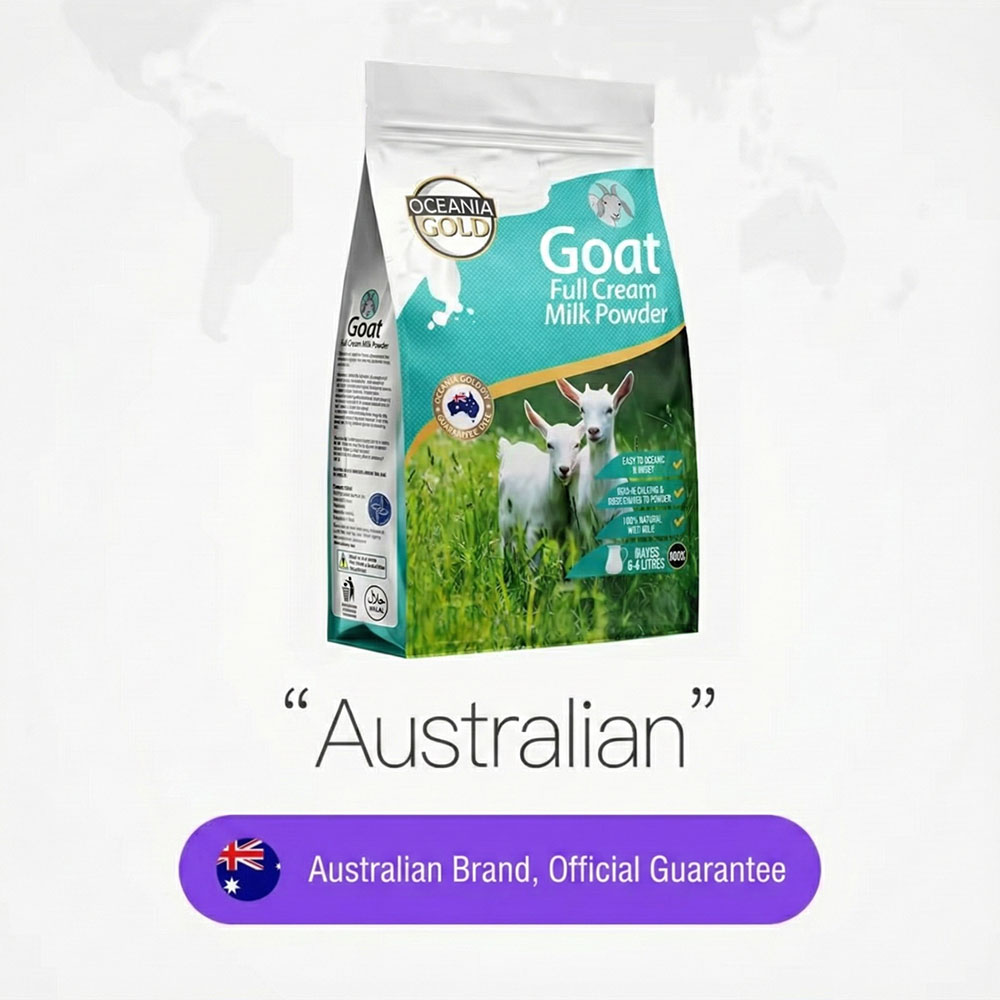
Our OCEANIA GOLD Goat Milk Powder 800g is sourced from a Victoria-based goat dairy and manufactured via wet-mix single-pass spray drying at Dairy-Pac International (Thomastown, VIC). Per 100g: protein 27.2g, calcium 1040mg, lactose 38.1g. Certifications: BRC, GMP, NASAA Organic, Halal, Kosher. EAN verifiable on GS1.org.
References
Written by the Sourcing & quality team — XYX Holdings Pty Ltd. Oceania Smart Select is the Australian product curation brand of XYX Holdings Pty Ltd (ABN 21 632 303 685). All claims are sourced from publicly verifiable industry standards or our own production specifications. Corrections or comments: contact us.
This article is published for general education and reflects information available at the time of writing. It is not medical, dietary, financial, or legal advice. Industry standards, product specifications, and regulations change over time — for decisions that affect your health, business, or compliance, consult a qualified professional and verify with the original authoritative sources we cite. We update articles when we notice material changes, but make no warranty of real-time accuracy.